
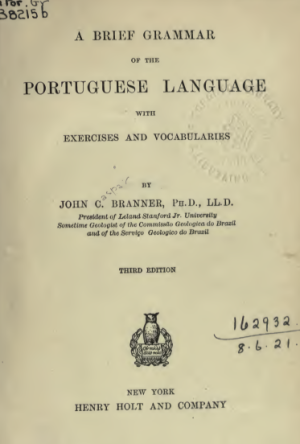
Título completo: A brief grammar of the Portuguese language with exercises and vocabularies
Local de publicação: Nova Iorque/Estados Unidos
Quantidade de edições: 9?
Editora: Henry and Company
Gramática escolar (LE)
- “This little book has been prepared for the use of English-speaking students who wish to get a practical knowledge of the Portuguese language.” (sic, preface, p. V).
- “The author has simply endeavored to follow the best Portuguese gram marians, and his own observations and experience with the language, in an effort to make it readily accessible to English-speaking students and in as compact a form as possible.” (sic, preface, p. V).
- “The chief object of this book is to encourage and facilitate the study of the Portuguese language and literature by English-speaking people.” (sic, preface, p. VII).
Gramática normativa
- “It has been kept in mind that such a work, in order to be useful, must keep practical points in view even at the expense of the erudite and more scholarly features of the language.” (sic, preface, p. VII).
- “The author has simply endeavored to follow the best Portuguese grammarians.” (sic, preface, p. V).
- “The book is purely elementary; those who require a thorough knowledge of the philologic and philosophic features of the tongue should consult the more pretentious works.” (sic, preface, p. V)
Gramática descritiva
- “Portuguese is a remarkably phonetic language, and one accustomed to the difficulties of the English, or even of the French, must be impressed with the comparative simplicity of its spelling.” (sic, preface, p. VII).
Gramática constrativa
- “The difference between the Portuguese spoken in Brazil and that spoken in Portugal is similar to the difference between the English of North America and the English of England— one about which the foreigner need not seriously concern himself.” (sic, preface, p. VII).
- “Portuguese is a remarkably phonetic language, and one accustomed to the difficulties of the English, or even of the French, must be impressed with the comparative simplicity of its spelling.” (sic, preface, p. VII).
- “It is true that one hears purely local terms and expressions in various parts of Brazil, but so he does in Portugal and, for that matter, in all languages and in every other part of the world.” (sic, preface, p. VII).
OBJETIVOS DO AUTOR
- “This little book has been prepared for the use of English-speaking students who wish to get a practical knowledge of the Portuguese language.” (Preface, p. V).
- “The chief object of this book is to encourage and facilitate the study of the Portuguese language and literature by English-speaking people.” (Preface, p. VII).
- “The author has simply endeavored to follow the best Portuguese grammarians, and his own observations and experience with the language, in an effort to make it readily accessible to English-speaking students and in as compact a form as possible.” (Preface, p. V).
- “It is not claimed that there is much that is new or original in the work. The author has simply endeavored to follow the best Portuguese grammarians.” (Preface, p. V).
ESTADO DA ARTE
- SILVA, Ana Alexandra; MARÇALO, Maria João. António Vieira e John C. Branner – A Morfologia Revisitada. Gramáticas Antigas de Português Língua Estrangeira. In: VAL ÁLVARO, José Francisco et al (Eds.). De la unidad del lenguaje a la diversidade de las lenguas. Universidad de Zaragoza, 2013, p. 830-842.
- FONSECA, Maria do Céu; MARÇALO, Maria João; SILVA, Ana Alexandra. O Português como Língua Estrangeira em Gramáticas Antigas: aspetos do contexto anglófono. SprachWissenschaftsGeschichte I, p. 21.
REFERÊNCIA:
BRANNER, John Casper. A Brief Grammar of the Portuguese Language. 3° ed. New York: Henry Holt and Company, 1910.


