
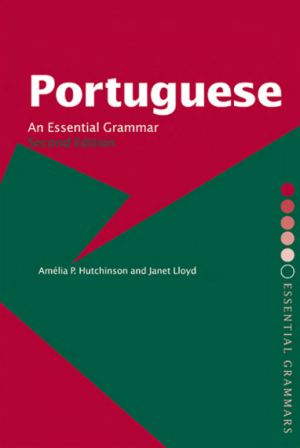

Título completo: Portuguese: An Essential Grammar
Local de publicação: Reino Unido (Londres) / Estados Unidos (Nova Iorque) publicado ao mesmo tempo.
Quantidade de edições:1° ed. – 1996; 2° ed. – 2003; 3° ed. – 2018.
Editora: Routledge
Gramática escolar (LE)
- “The Grammar is the ideal reference source for the learner and user of Portuguese. It is suitable for either independent study or for students in schools, colleges, universities and adult classes of all types.” (sic, introduction, p. v).
- “This book provides coverage of both European and Brazilian Portuguese and information on the lexical differences between the two, making it ideal for learners from diverse linguistic backgrounds.” (sic, introduction, p. v).
- “We have attempted to cater for different groups of students, each with their own needs: the beginner, who may not have an extensive knowledge of grammatical concepts and terminology; the intermediate–advanced student, who appreciates a clear reference book in moments of doubt.” (sic, foreword to the first edition, p. xiv).
Gramática normativa
- “The Grammar combines traditional grammar with descriptions of functions, aiming to cover the complexities of Portuguese usage in short, accessible sections.” (sic, Introduction, p. v).
- “The Grammar is the ideal reference source for the learner and user of Portuguese.” (sic, introduction, p. v).
- “Grammar is a systematic guide to understanding the complexities of the Portuguese language, helping learners to use the language effectively and correctly.” (sic, Introduction, p. v).
Gramática constrativa
- “This book provides coverage of both European and Brazilian Portuguese and information on the lexical differences between the two, making it ideal for learners from diverse linguistic backgrounds.” (sic, introduction, p. v).
- “We have tried to make the book as ‘neutral’ as possible, bearing in mind the differences between European Portuguese, Brazilian Portuguese, and the Portuguese spoken in the Lusophone African countries.” (sic, Foreword to the first edition, p. xiv).
Gramática descritiva
- “Above all, we have aimed to produce a ‘user-friendly’ handbook with concise explanations of areas of grammar and comprehensible examples taken from current Portuguese usage.” (sic, foreword to the first edition, p. xiv).
- “We have tried to make the book as ‘neutral’ as possible, bearing in mind the differences between European Portuguese, Brazilian Portuguese and the Portuguese spoken in the Lusophone African countries.” (sic, Foreword to the first edition, p. xiv).
- “This book reflects current teaching methodologies and aims to balance traditional grammar and language functions.” (sic, Introduction, p. v).
OBJETIVOS DO AUTOR
- ” The aim of this work is to offer the student of Portuguese a succinct and reasonably comprehensive overview of Portuguese grammar.” (sic, foreword to the first edition, p. xiv).
- “Above all, we have aimed to produce a ‘user-friendly’ handbook with concise explanations of areas of grammar and comprehensible examples taken from current Portuguese usage. This latter point is significant, given our firm belief that grammar should not stand divorced from usage. Nevertheless, the ‘essential’ nature of this work means that we have been obliged to use short illustrative phrases or sentences out of context.” (sic, foreword to the first edition, p. xiv).
- “We have tried to make the book as ‘neutral’ as possible, bearing in mind the differences between European Portuguese, Brazilian Portuguese and the Portuguese spoken in the Lusophone African countries. Although we have taken European Portuguese as our starting-point, we have indicated the most marked differences between this and Brazilian grammar and usage in Part III. We have aimed, thus, to cover both ends of the spectrum. As African Portuguese falls somewhere between these two extremes with diver gences which are more lexical than grammatical, we have decided not to extend this work into that area.” (sic, foreword to the first edition, p. xiv).
- “If, with this product of our effort, we can assist a wider range of people in learning and developing their knowledge of Portuguese, the eighth most spoken language in the world, we will consider ourselves well rewarded.” (sic, foreword to the first edition, p. xv).
- “Our objective is to lead the reader or new learner to develop a ‘mid-Atlantic’ command of Portuguese that can be used anywhere in the Portuguese-speaking world. Any speaker can have control over the variant of Portuguese that he/she wishes to use, but that control cannot be exercised over their interlocutors, hence the need to be prepared to meet the challenges posed by speakers from all corners of the Portuguese diaspora. We have also improved the translation of many examples.” (sic, foreword to the second edition, p. xviii).
- “We have added Part IV, which contains cultural notes on the origins of Portuguese, its role as an international language, and its use in forms of artistic expression such as literature, music and film. These notes are far from being extensive. Their objective is merely to offer the reader a taster of Portuguese as a living language, and an instrument of linguistic and artistic communication for nearly two hundred million native speakers scattered around the world. In all other regards, our objectives are the same as stated in the first edition.” (sic, foreword to the second edition, p. xviii).
CONCEPÇÃO DE LÍNGUA, NORMA E GRAMÁTICA
Gramática
- “Grammar is a systematic guide to understanding the complexities of the Portuguese language, helping learners to use the language effectively and correctly.” (sic, Introduction, p. v).
ESTADO DA ARTE
- MENDES, Mafalda; MARTINS, Mário. (Mis) Guided interpersonal deictic choices in primary school writing under language assessment. Linguistics and Education, v. 69, p. 101035, 2022.
- SIEGEL, Jeff. The emergence of pidgin and creole languages. Oxford University Press, 2008.
- CHO, Won Ik et al. Towards cross-lingual generalization of translation gender bias. In: Proceedings of the 2021 ACM Conference on Fairness, Accountability, and Transparency. 2021. p. 449-457.
REFERÊNCIA:
HUTCHINSON, Amélia Pereira; LLOYD, Janet. Portuguese: an essential grammar. 2°ed. New York: Routledge, 2003.