
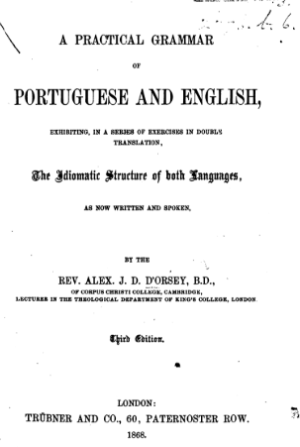

Título completo: A Practical Grammar of Portuguese and English, exhibiting, in a series of exercises in double translation, the idiomatic structure of both languages, as now written and spoken, adapted to Ollendorf’s system.
Local de publicação: Lisboa/Portugal
Quantidade de edições: 4° edições? 1° ed. – 1853 (Madeira, Lisboa); 2° ed. – 1860 (Primeira edição publicada em Londres); 3° ed. – 1868; 4° ed. – 1887;
Editora: Trübner and co.
Gramática descritiva
- “And, though a brief treatise like the present cannot contain names and references, the very words of the writers [sic] ought in all cases to be given, as ensuring purity of style, and exemplifying the actual state of the language.” (preface, p. vi);
- “The compiler of a grammar, therefore, instead of theorizing, ought rigidly to follow the principles of inductive science, and frame his rules on an extensive and impartial examination of all the forms of speech, as exhibited in modern standard works, periodical literature, parliamentary debates, and ordinary conversation.” (preface, vi);
Gramática escolar (LE)
- “The manner of using this Grammar will, of course, be modified by the views of the teacher and the requirements of the pupil;” (preface, p. vi);
- “Several pages are intended more for the Portuguese than the English student, such as 17, 18, etc., and may be neglected by the latter.” (preface, p. vii);
- “The learner should bear in mind that the successful study of a foreign tongue requires a previous knowledge of his own, that there is no royal road to languages any more than to geometry, and that the ordinary hope of being able to ‘pick up’ Portuguese without labour, [sic] by living in Portugal, and associating with peasants and servants, is a pure delusion; for ‘less than thorough will not do it’.” (sic, preface, p. vii – viii).
- “[…] but it is suggested that an hour should be devoted to each page, that the teacher should first read the foreign language slowly, making the pupil imitate, and that there should be constant oral examination and practice in viva voce double translation, before writing the illustrations. Afterwards, the pupil should write out both exercises for correction by the teacher.” (preface, p. vii);
- “In conjunction with his course of practical grammar, the student is recommended to commit to memory daily a page, or at least half a page, of the “Colloquial Portuguese.” (preface, p. vii).
Gramática constrativa
- O livro apresenta e compara as estruturas idiomáticas do português e do inglês, destacando diferenças e semelhanças entre as línguas. Isso fica claro no método de “exercícios em tradução dupla”, onde frases em português devem ser traduzidas para o inglês e vice-versa;
- “Every page contains a ‘LESSON,’ consisting of three parts. First, the rule or precept, placed first for the sake of form, but really being the inference from the authorities quoted; secondly, Portuguese sentences, in strict relation to the rule, for translating into English; thirdly, English phrases for rendering into Portuguese.” (preface, p. vi).
- Título: “A Practical Grammar of Portuguese and English, exhibiting, in a series of exercises in double translation, the idiomatic structure of both languages, as now written and spoken, adapted to Ollendorf’s system.”
Gramática normativa
- O autor defende que uma gramática deve ser fundamentada em exemplos de escritores renomados e que o aprendizado deve seguir regras formais, o que confere à obra um caráter normativo em alguns aspectos.
- “Every page contains a ‘LESSON,’ consisting of three parts. First, the rule or precept, placed first for the sake of form, but really being the inference from the authorities quoted;” (preface, p. vi);
- “It may, I think, be laid down as a principle, that no Grammar is worthy of the name which does not support its rules by quotations from the best authors.” (preface, p. vi).
- “My friend and colleague, Senhor da Costa Ricci, Professor of Portuguese at King’s College, has most kindly revised the proof-sheets of this edition, so that, it is hoped, no material error will be found in the work.” (preparatory note to the third edition, p. viii).
OBJETIVOS DO AUTOR
- Título: A Practical Grammar of Portuguese and English, exhibiting, in a series of exercises in double translation, the idiomatic structure of both languages, as now written and spoken, adapted to Ollendorf’s system.
- “The peculiar plan on which this Grammar* is constructed “will be so evident to the habitual student, from a mere inspection of any of its pages, that it seems hardly necessary to introduce it with the now almost stereotyped formality of a preface.” (preface, p. v).
- “The plan may be called a copy or adaptation of Ollendorf’s and Arnold’s, for there is certainly enough of resemblance to justify the comparison; but, from having used the textbooks of both authors in teaching classics and foreign languages, I can safely say that this little work is not a servile imitation.” (preface, p. vi).
- “The compiler of a grammar, therefore, instead of theorizing, ought rigidly to follow the principles of inductive science, and frame his rules on an extensive and impartial examination of all the forms of speech, as exhibited in modern standard works, periodical literature, parliamentary debates, and ordinary conversation. Such is the basis on which this work has been founded.” (preface, p. vi);
- “At present there is no good dictionary of the English and Portuguese languages; but one is in preparation by the writer of this grammar.” (preface, p. vii).
ESTADO DA ARTE
- DE SOUSA, Maria Leonor Machado; BIRNE, Maria Teresa Real. Portugal e os Estrangeiros. Revista de Estudos Anglo-Portugueses, n. 12, p. 9-25, 2003.
REFERÊNCIA:
D’ORSEY, Alex. J. D. A practical grammar of Portuguese and English, exhibiting, in a series of exercises in double translation, the idiomatic structure of both languages, as now written and spoken, adapted to Ollendorf’s system. 3ª ed. London: Trübner and Co., 1868 [1853].